Say you have an AI bot whose whole job is checking prices. Every morning it visits a store's website and reports, "these headphones cost ₹2,999."
One day the price goes up to ₹3,499. But the bot keeps saying ₹2,999. Maybe the page layout changed, maybe it's reading an old copy. Either way, nothing crashes, there's no error, and the bot looks perfectly healthy.
It's just wrong.
That's the scary part about AI agents that browse the web. They don't fail loudly. They fail quietly, with confident, out-of-date answers.
So I built Agent Census: a system that watches these bots and checks their work.
It's basically a manager doing spot checks
Think of a manager with a team of interns, each one collecting info from websites. A good manager doesn't just trust the reports. Now and then they open the website themselves and compare.
That's exactly what Agent Census does, except the manager is four AI agents working together:
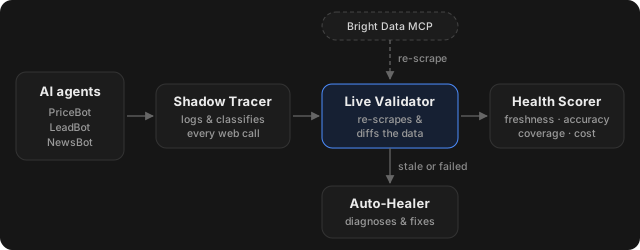 Every web visit gets logged, re-checked against the real page, scored, and fixed if something went wrong.
- Shadow Tracer is the notebook. It writes down every website visit the bots make.
- Live Validator is the spot check. It visits the same page again (through Bright Data's scraping service) and compares what's really there with what the bot reported.
- Health Scorer is the report card. It grades each bot on four things: is the data fresh, is it accurate, did it cover everything, and how much did it cost.
- Auto-Healer is the fixer. When something breaks, it figures out why and suggests a fix.
Why check the page again? Can't you just read the logs?
Nope. That's the whole trick.
If the bot read an old price, its logs will happily say "found price: ₹2,999, success!" The logs only know what the bot thought it saw. The only way to catch it is to go back to the actual website and look.
That's why the Live Validator sits right in the middle. What it finds decides both the report card and whether the fixer gets called.
Try it without any setup
It comes with a demo mode that uses fake scrapers, so you don't need any API keys. The demo:
- Creates 50 past website visits from three made-up bots: PriceBot, LeadBot and NewsBot.
- Re-checks some of them and catches stale data, like changed prices, outdated job titles and old news.
- Runs the fixer on stuff that broke, like getting blocked, hitting rate limits, or a page layout changing.
- Gives each bot a health score.
Then the dashboard shows a card per bot (green for healthy, yellow for struggling, red for critical), a live feed of checks with before and after views, alerts when stale data shows up, fix suggestions, and a chart of money spent versus useful data actually collected.
What it's built with
CrewAI to run the four agents together, FastAPI for the backend, SQLite to store everything, Bright Data for re-checking pages, and a Next.js dashboard (plus a Streamlit one if you prefer Python).
The big idea
If AI agents are going to do real work on the internet, someone has to check on them. The same way you'd check a new hire's work in their first few weeks: go to the source, compare, give feedback, fix what's broken.
Most agent demos skip that part. This one is only that part.
Code is here: github.com/parthchilwerwar/Agent-Census.
Sources
- Agent Census on GitHub: the code, API endpoints and demo
- CrewAI docs: the framework that runs the four agents together
- Bright Data MCP server: what the Live Validator uses to re-check pages
- FastAPI docs: the backend framework